


PSA: ATTN: FYI: We are moving past the era of the “exit by default.”

For years, the beverage industry operated on a playbook that prioritized rapid expansion and high-level storytelling, often at the expense of commercial viability. But as the market matures, the expectations from investors have shifted toward a more tactical realism.
To understand what it takes to actually move the needle today, I sat down with Emile Ward (an investor and operator who successfully navigated an exit with Gin Foundry). His perspective is rooted in the transition from selling others’ brands to investing in the next wave of leaders.
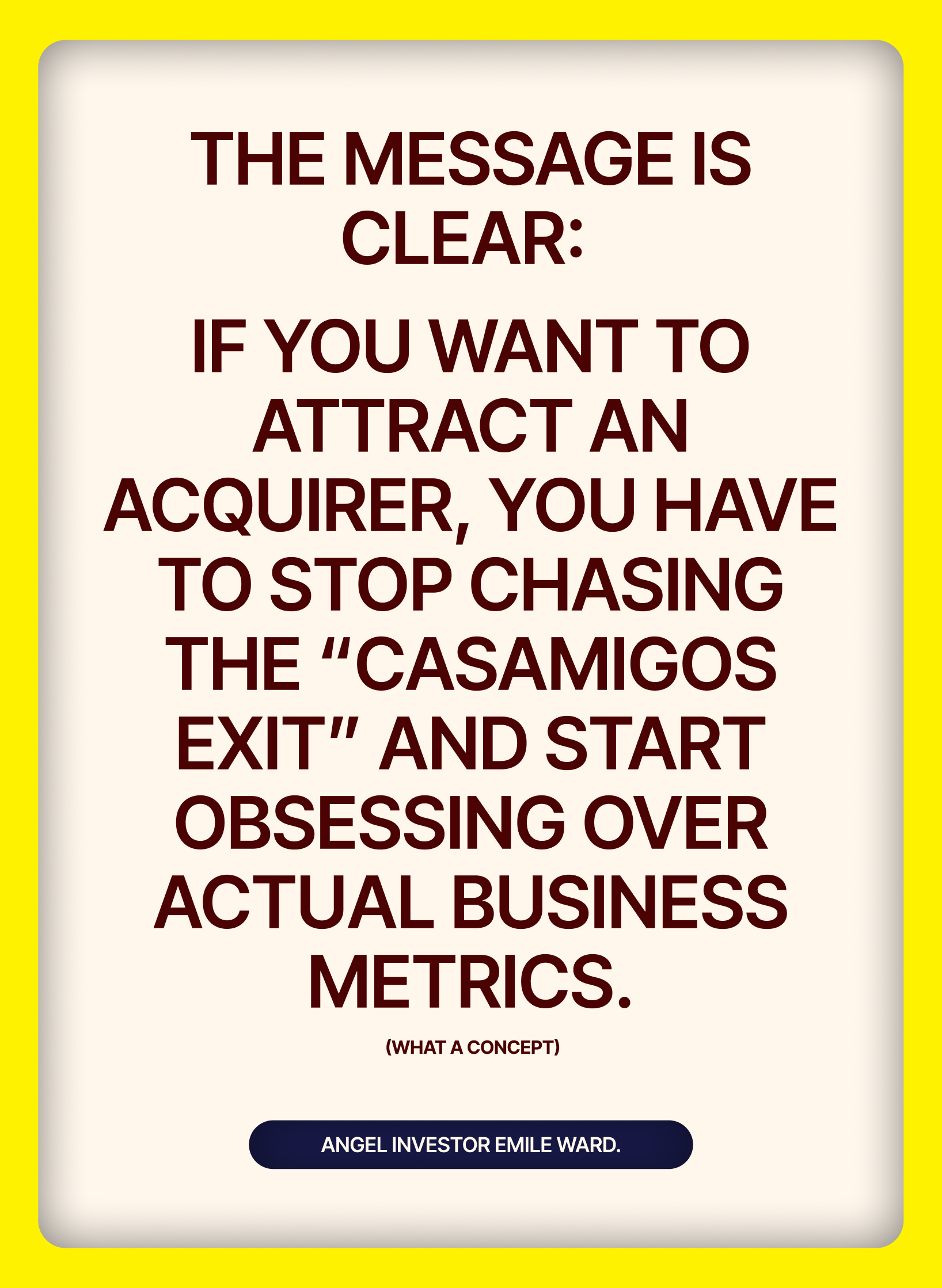
The message is clear: if you want to attract an acquirer, you have to stop chasing the “Casamigos exit” and start obsessing over actual business metrics (what a concept).
The Trap of the Generic Exit
One of the most common mistakes founders make is populating their pitch decks with the same pool of “logical” acquirers (think Diageo or Pernod Ricard) without considering if they actually fit the portfolio. Emile notes that this often signals a lack of market depth.
"They (naive founders) tend to put the same pool of acquirers as their potential exit. It’s always Diageo, Pernod Ricard, Bacardi… and it’s just not realistic. It doesn’t show that you know the market well enough."
Instead of aiming for the giants immediately, look at the layers beneath. We are seeing a rise in medium-sized brands, distributors, and cross-category movers taking center stage. For example, the acquisition of Alani Nu by Celsius, Whiny Baby by Gallo, or Lalo Tequila by Tito’s proves that target audience alignment can be more valuable than category tradition. A realistic exit strategy requires networking with the players who actually need your specific community or distribution plug-and-play.
Why Velocity is the Only Truth
For years, many founders focus on the “vanity metric” of total doors. Or appearances (we sponsored this party! we hired this person for content!). They want to be everywhere at once, hoping that sheer presence equals success. Today’s investors see right through this.
Listen carefully: The core indicator of your brand’s health is not how many accounts you have, it is how quickly those accounts are reordering. High velocity in a few key accounts is infinitely more valuable than a single dusty bottle sitting on a shelf in a thousand stores. If you cannot prove repeat purchase and increasing order rates over time, you do not have a brand (you have a one-time trial).
The New Investor Checklist
When you are looking to scale in this environment, these are the strategic shifts you need to internalize:
The Omnichannel Necessity: While D2C is vital for community building and testing limited editions, beverage is won in distribution—the on-trade and off-premise. Emile has deep D2C experience, and shares below when it makes sense for a brand to focus on D2C.
Leveraging Editorial Depth: Emile’s success with Gin Foundry was rooted in its dual nature as both a highly-trafficked editorial platform and a direct-to-consumer marketplace with hundreds of SKUs. This provided the “weight” needed to enter the market with authority.
Margin Discipline: The days of burning cash for top-line growth are over. Investors want to see a clear plan for reducing COGS and maintaining tight control over gross margins as you scale.
Hiring Above Yourself: Successful founders identify where they are weak and hire people who outsmart them in those areas. Humility in leadership is often the deciding factor in whether a brand can survive the transition from founder-led to a scaled operation.
Categories to Watch
Beyond the crowded non-alc and functional water spaces, there are pockets of opportunity where cultural intelligence is being applied to “unsexy” categories:
Healthy Condiments: Salad dressings and pantry staples that treat food as a lifestyle signal.
The “Better-for-You” Indulgence: Probiotic or protein-enriched treats that bridge the gap between wellness and hedonism.
The Wine Rebrand: Wine has the history and the lower ABV that a new generation craves, but the branding and formats (cans, boxes) are still catching up to the culture.
Building a System, Not Just a Story
The goal is not to tell the most beautiful story, it is to build a commercial system that works. The story should back that up, not the other way around. Investors are not buying your “vision” (they are buying your proof of adoption).
As Emile reminded us, "It’s easy to sell something once, but it’s really hard to sell something twice."
The brands that earn a permanent spot in a consumer’s routine are the ones that stop being a trend and become a staple.
The New Rules is a labor of love by nihilo.agency
Need design support for your brand? Reach out! hi@nihilo.agency
And support our work by:
- Subscribing
- Sharing
- Inviting us to speak at your conference or event on branding/bev/alc/fun
Cheers.