


PSA: there’s no jacuzzi without the plumbing.
Chris Maffeo’s family ran a wholesale business outside Naples for three generations, starting with his great-grandfather in 1884 and ending when his grandfather passed and the business closed after a hundred years and two world wars.
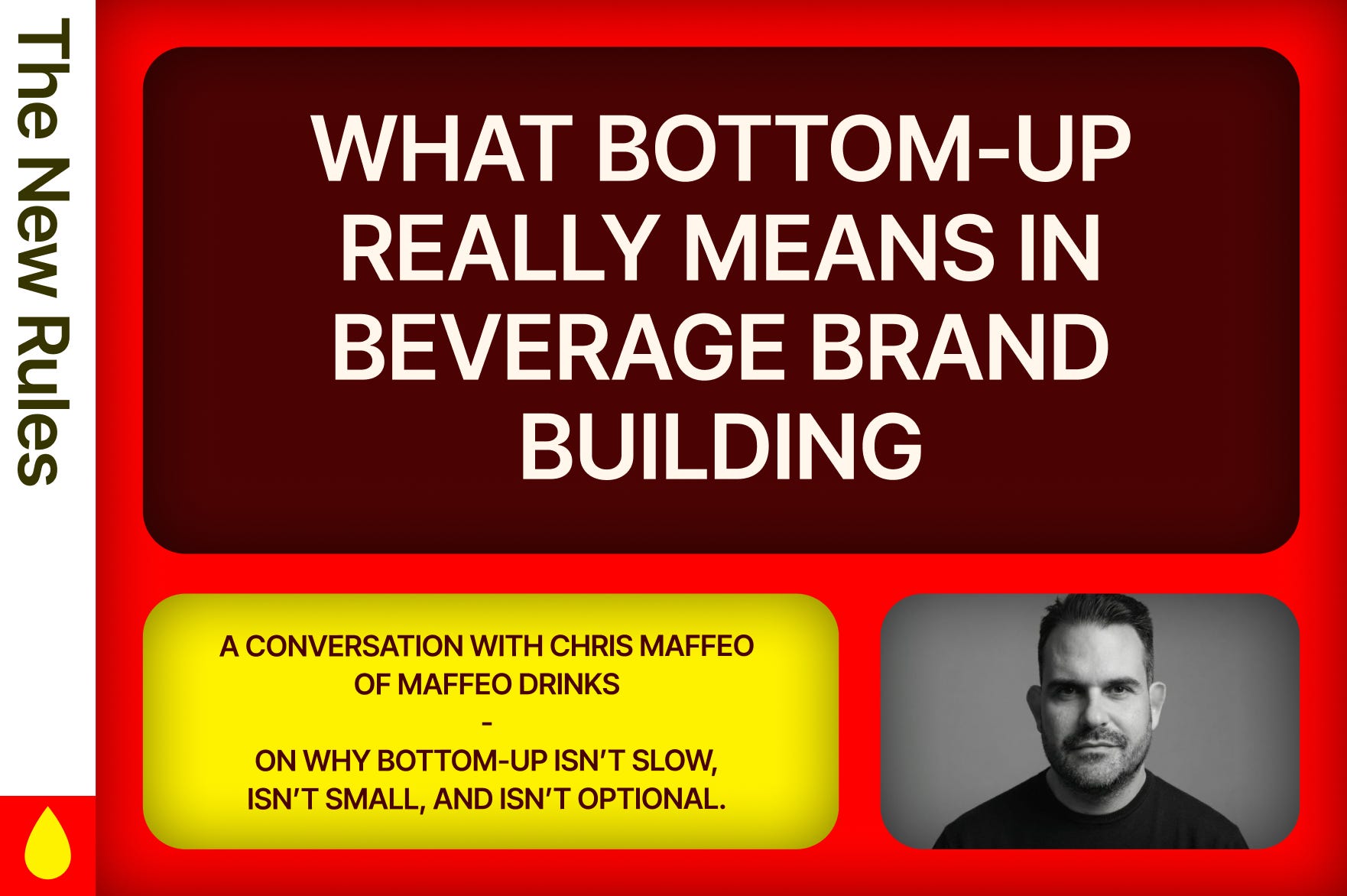
Chris went on to spend years in export roles at SABMiller, Asahi, and Carlsberg, working alongside wholesalers and importers the whole time, before he left corporate to start Maffeo Drinks. His reasoning was simple: nobody was documenting what actually works in brand building anymore, because the people who know are always too busy running the business to write it down.
The phrase “bottom-up” started as one line in a LinkedIn post. People kept quoting it back to him, so he built a whole body of work around defining it properly, mostly because most people who repeat it still get it wrong.
Bottom-up doesn’t mean small
The biggest misconception, according to Chris, is that bottom-up means slow, or one relationship at a time, or staying small on purpose. It doesn’t.
“For me, bottom-up is basically working on the foundations, mastering the unscalable things first before you can scale your brand. If you want a nice penthouse with a rooftop and a jacuzzi, you need the building to have solid foundations and the plumbing has to work, because otherwise there’s no jacuzzi without the plumbing.”
Testing bottom-up doesn’t mean grinding through a hundred bars one by one either. It means working with five bartenders and two importers and three bar owners long enough to actually understand the pattern, then refining the approach before trying to build at scale.
Drinks brands are B2B2B2C, not B2C
This is where Chris sees founders lose the most time. Because the end product is something a consumer drinks, founders build like consumer brands from day one: a strong Instagram, a big launch party, a killer activation.
What they skip is everything underneath it, the importer, the distributor, the bar owner, the bottle shop clerk, all the tiers that actually have to say yes before a consumer can ever find the product on a shelf or a menu.
A beautiful consumer brand with no distribution infrastructure isn’t a brand yet. It’s a very expensive party.
He talked about a recent podcast conversation with Mark Ward of Regal Rogue, titled “When Your Brand Stops Being Yours,” about the exact moment a founder walks out the door with an idea and finds out the market has its own interpretation of it.
The only way through that gap, in Chris’s view, is for the founder to go sell it themselves first. Not because a distributor or ambassador can’t eventually do it, but because a founder who’s never absorbed 50 nos in person has no idea what they’re actually asking someone else to do on their behalf.
The boring math nobody wants to learn
Founders love talking about their thousand-case goal. Chris wants them talking about the first bottle.
He walks through the actual mechanics: how big is the bottle, how big is the pour in that market, how many drinks does that translate to, and what does it take to sell one more drink a night at a single bar.
Twelve drinks in a bottle, on a bar open six nights a week, is two drinks a night. Getting a bar from half a bottle a week to a full one is one more drink, per night. That’s the conversation Chris thinks founders should be having instead of talking exits and case counts they haven’t earned yet.
None of this is about the perfect garnish or an invented signature serve. It’s usually a small twist on a drink that’s already selling in that specific bar.
You can’t outspend the big guys, so don’t try
On pay-to-play, Chris used an image that’s stuck with me: if a truck is chasing you, you don’t try to outrun it on the highway, you duck into the alley it can’t fit into.
Differentiation has to be sharp enough that a $2 price difference makes sense to an importer or a bar owner on its own terms, not because you outspent someone with a bigger budget.
The brands he points to as proof that this actually compounds are ones that never stopped repeating their fundamentals even after becoming famous.
Aperol Spritz took twenty years to become ubiquitous. Hendrick’s, launched in 1999, still talks about cucumber and the gin and tonic serve in nearly every market, over two decades in. Peroni was disciplined for years about serving in the Peroni glass, on draft, nothing else. Guinness still makes you wait for the pour. None of them decided they’d earned the right to stop explaining themselves.
The rule for a down market
Asked for one rule going into 2026, Chris didn’t reach for anything about growth.
“Don’t do anything today that you suspect may jeopardize tomorrow. Opportunities materialize and they look like fast growth, but they can ruin your financials or your brand’s image. I’ve seen many brands fail by being too successful too soon.”
THE NEW RULE: bottom-up isn’t a pace, it’s an order of operations. Master the boring, invisible stuff first. Everything you actually want, the culture, the scale, the moment, only holds up if it’s sitting on something solid.
The New Rules is a labor of love by nihilo.agency
Need design support for your brand? Reach out! hi@nihilo.agency
And support our work by:
Subscribing
Sharing
Inviting us to speak at your conference or event on branding/bev/alc/fun
Cheers.