In the agency world, the ultimate asset is usually a beautiful render—getting to that perfect final case study, putting your finest work on the Dieline, and securing the press hits. Most people don't expect their branding agency to do end-to-end execution, including liquid strategy.
But Mike Perry, owner of the Brooklyn-based beverage branding agency Tavern, wants his clients to know that Tavern does exactly that. As he points out, “no one knows the deep strategy that goes into it. No one knows the liquid strategy, which is what we work on with a lot of our major clients.”
For years, Tavern has operated deep in the trenches of the beverage-alcohol sector for global conglomerates like Beam Suntory and E. & J. Gallo.
Yet, when you’re an agency servicing massive corporate clients, it’s hard to show early-stage founders and venture capitalists that you actually understand the gritty, end-to-end reality of launching a brand from scratch.
So, Perry decided Tavern would write its own brief.
They set out to build a physical product to prove they could handle the entire roadmap—from liquid formulation to distributor pitches. What started as a clever marketing exercise, however, quickly spiraled into something much bigger. They built a product and brand so compelling they had no choice but to go all-in.
The Proof of Concept: Handling the End-to-End Roadmap
To prove to clients and skeptical VCs that Tavern wasn’t just a design shop, Perry wanted a single, highly tactical case study that demonstrated a deep understanding of the entire beverage lifecycle.
As Mike puts it:
“One thing we’re trying to achieve with this is to show that we’re deep experts in this category. We’ve demonstrated that understanding in the past, but this time we’re doing it through a single brand that can act as a case study. It’s not just about liquid strategy and product development, it’s also about getting a brand onto shelves and understanding how to pitch it to distributors.
Tavern didn’t want to just mock up a concept; they handled the logistical heavy lifting. They mapped out a lean distribution framework, proving to early-stage founders that you don’t need massive, wasteful budgets to make an impact:
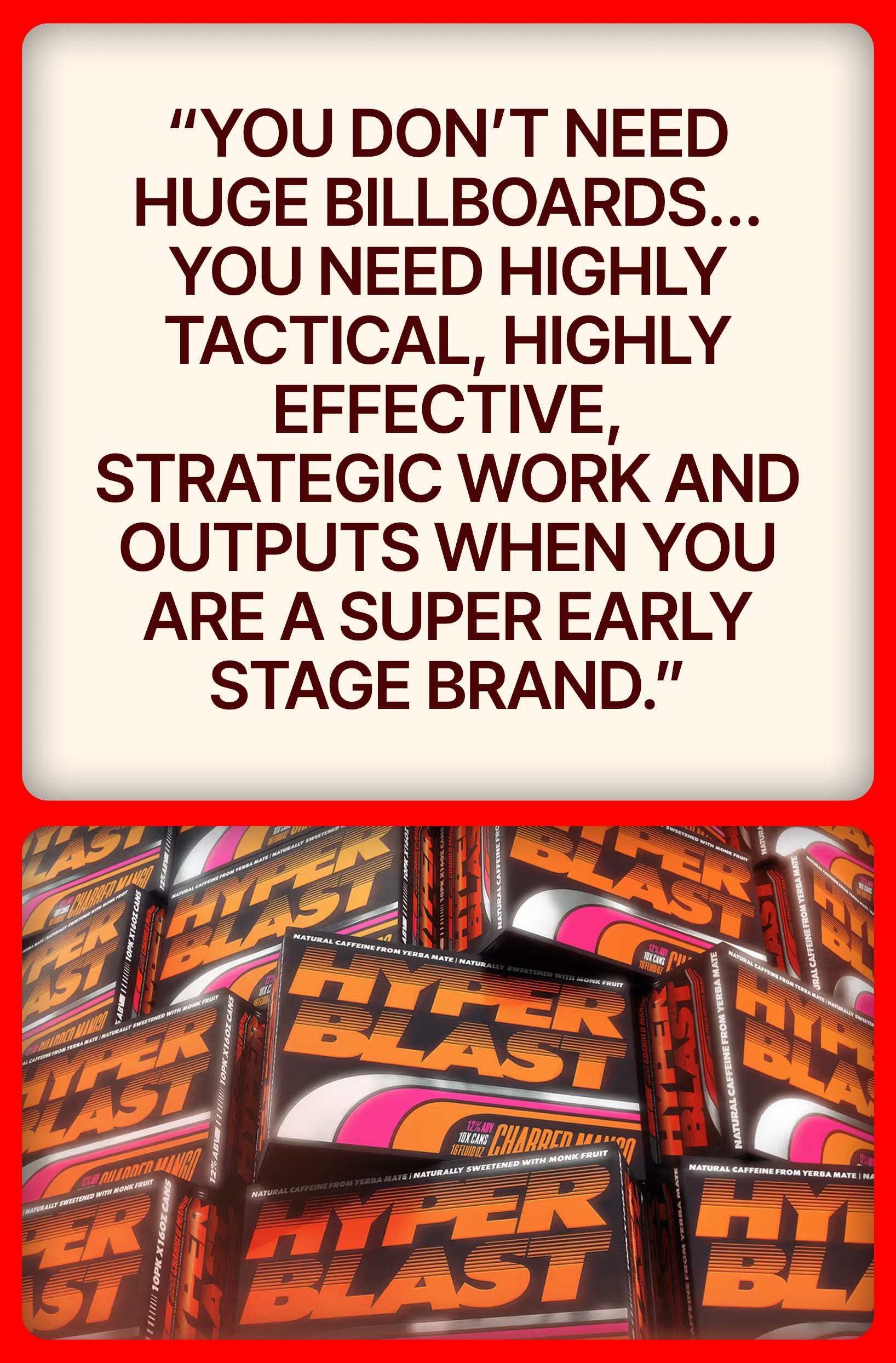
“You don’t need huge billboards. I think a lot of companies will come in and try to sell you a bunch of stuff you don’t actually need. When you’re a super early-stage brand, what you need is highly tactical, highly effective, strategic work and outputs that can have an immediate impact.”
History Doesn’t Repeat Itself but It’s Rhyming Pretty Hard
Mike didn’t want to just make a random RTD. He built off his understanding of how trends are resurfacing in different forms. I found this interesting:
The Pivot: When a Case Study Rules Too Hard to Ignore
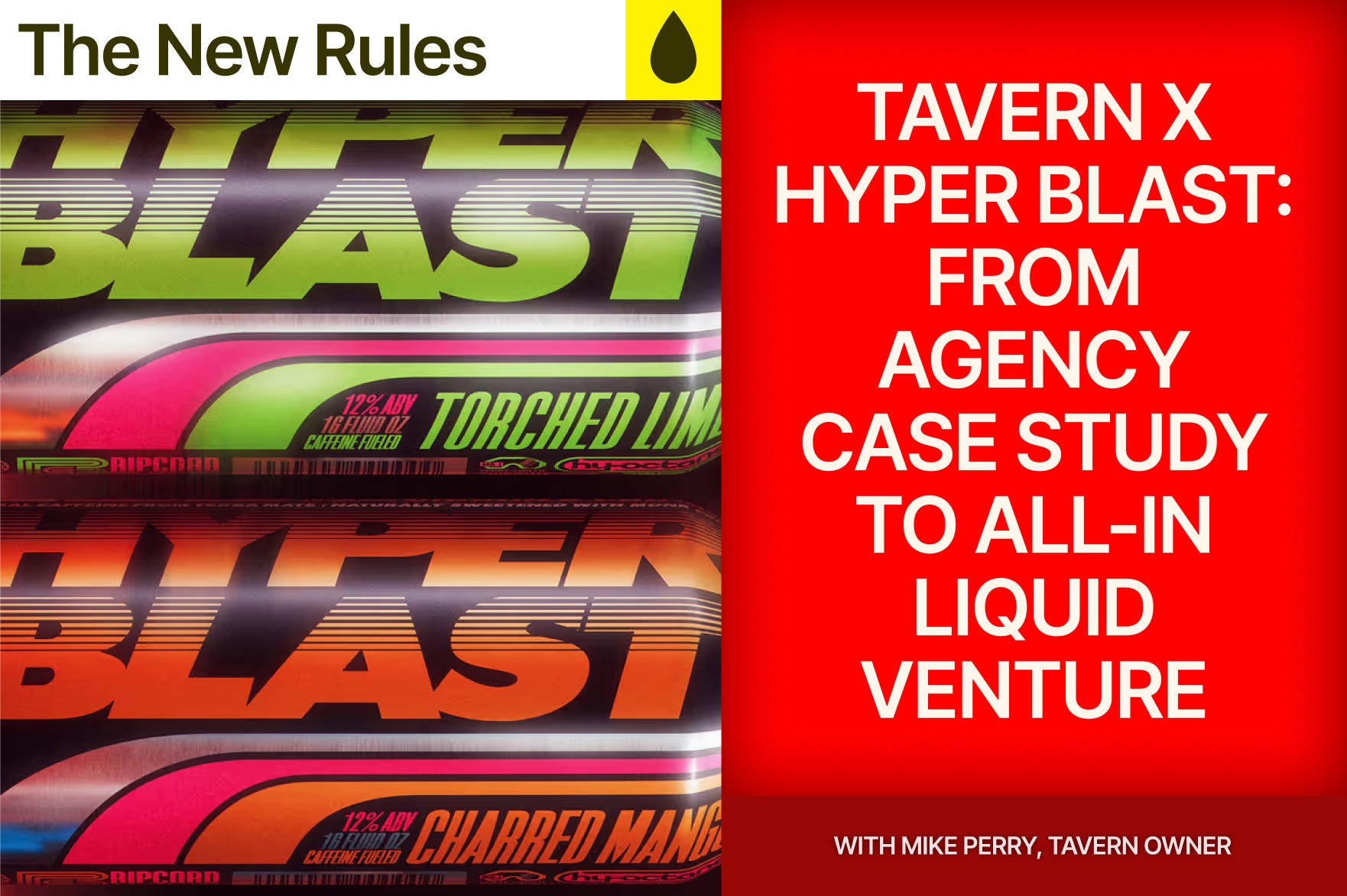
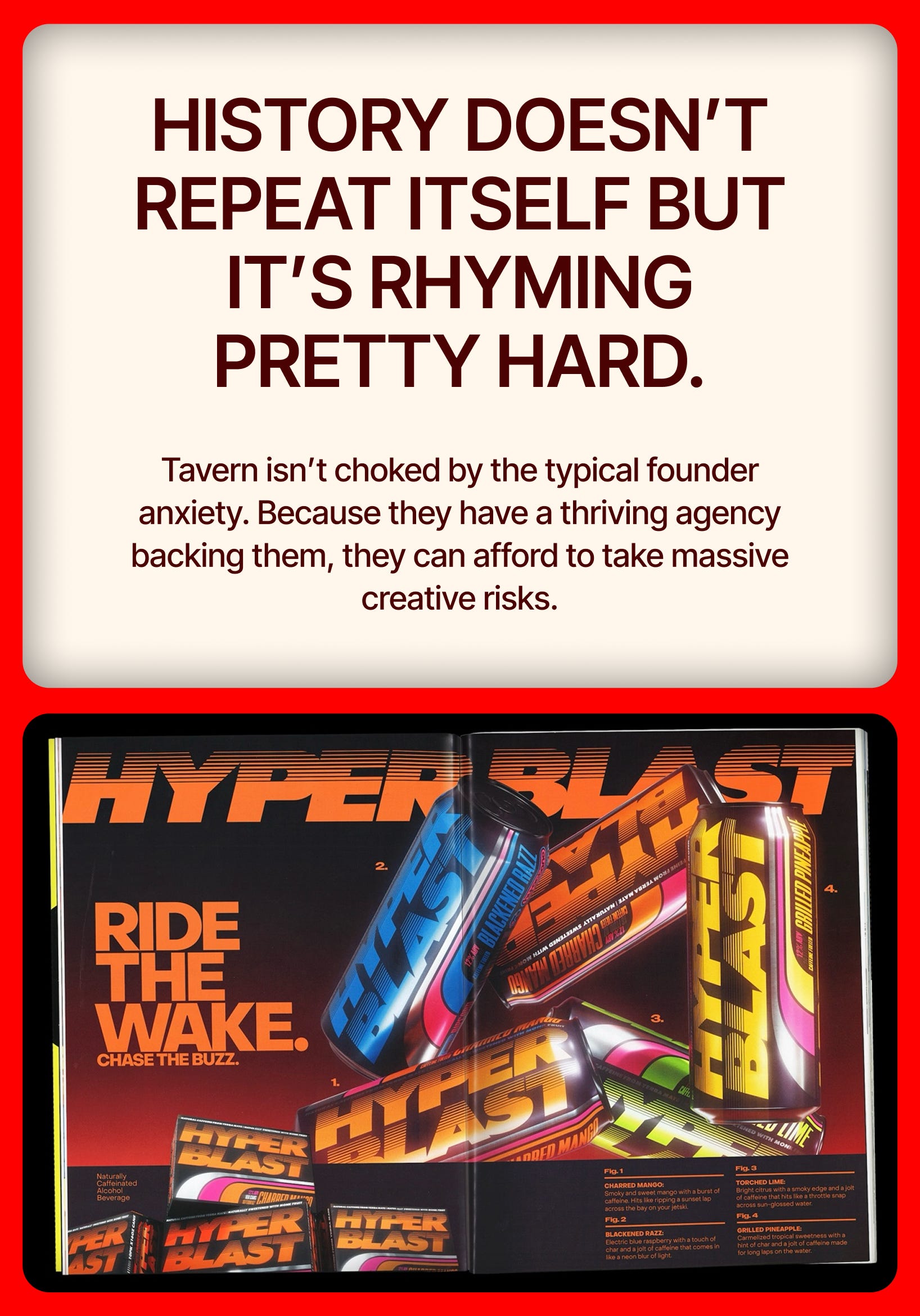
The vehicle for this masterclass in brand building was Hyper Blast, an upcoming 12% ABV RTD inspired by late-2000s alcoholic energy drink culture. Tavern designed a massive, rich brand world around 80s and 90s jet ski culture, mapping out an entire universe of physical, ancillary products like riding grips and fuel jerry cans to show how far a single creative concept could expand.
Originally, the plan was simple, lean, and highly risk-averse: soft-launch the brand, create a killer case study, bootstrap it minimally, and maybe eventually offload the intellectual property to a major client.
Mike openly admits the plan was to “offload it as a PDF more or less.” But then they put the brand into the wild—and the market responded with absolute chaos.
The market reaction was so overwhelmingly positive, and the structural fit between millennial nostalgia and Gen Z’s love for high-octane RTDs was so perfect, that the agency realized they were sitting on a goldmine.
Mike describes the exact moment the strategy shifted:
“It started as the former. We’re like this f***ing rules. It’s so perfect. There is such a perfect time to enter the market with a product like this that it’s like we’d be fools not to just go full blast on it.”
Tavern quickly pivoted from a temporary design experiment to a fully invested beverage startup. They scrambled to build an investor deck, walked away from the bootstrap-and-sell model, and are now moving aggressively toward a summer launch.
Balancing the Agency and the Startup Burn
Going all-in on a liquid brand while running a 12-person agency is a logistical tightrope walk. To make it work without letting client work slip, Perry reallocated Tavern’s internal “design practice” hours—the time the team normally spends experimenting with new mediums and software—entirely to the execution of Hyper Blast asset builds, influencer kits, and campus launch materials.
It’s an exhausting pace, but Perry views the startup burn as an investment that feeds back into the agency’s primary mission. In his words:
“All of this should be in service of making everyone on the team, designer, strategist, even account people better at what they’re doing for our client work. So it serves us, but it also serves the client in the long term.”
And perhaps the secret ingredient to why Hyper Blast is generating so much organic momentum is that Tavern isn’t choked by the typical founder anxiety. Because they have a thriving agency backing them, they can afford to take massive creative risks.
As Mike bluntly puts it:
“Hyper Blast could be gone tomorrow, and that’s fine. Honestly, I think that’s part of why it might work. I’m not so f***ing precious about it in the way a lot of startup founders tend to be.”
By successfully taking Hyper Blast from an internal agency brief to a living, breathing retail product, Tavern didn’t just build a case study to show clients they could handle end-to-end strategy—they actually went out and proved it.
THE NEW RULE
The best way to prove you can do something is to go out and build it yourself. Stop waiting for a client brief to validate your team’s deepest strategic capabilities. Create your own incubator, run the hard yards from formulation to retail shelves, and don’t be afraid if your proof-of-concept takes on a life of its own. True expertise isn’t practiced on a slide deck—it’s proven in the market.
I wanted to share the following video because Mike is really talking about BRAND BUILDING in bev/alc in a super clear way.
For more on brand-building in the bev/alc sector, subscribe.


zomfg these designs are gasssss cottdamn!