


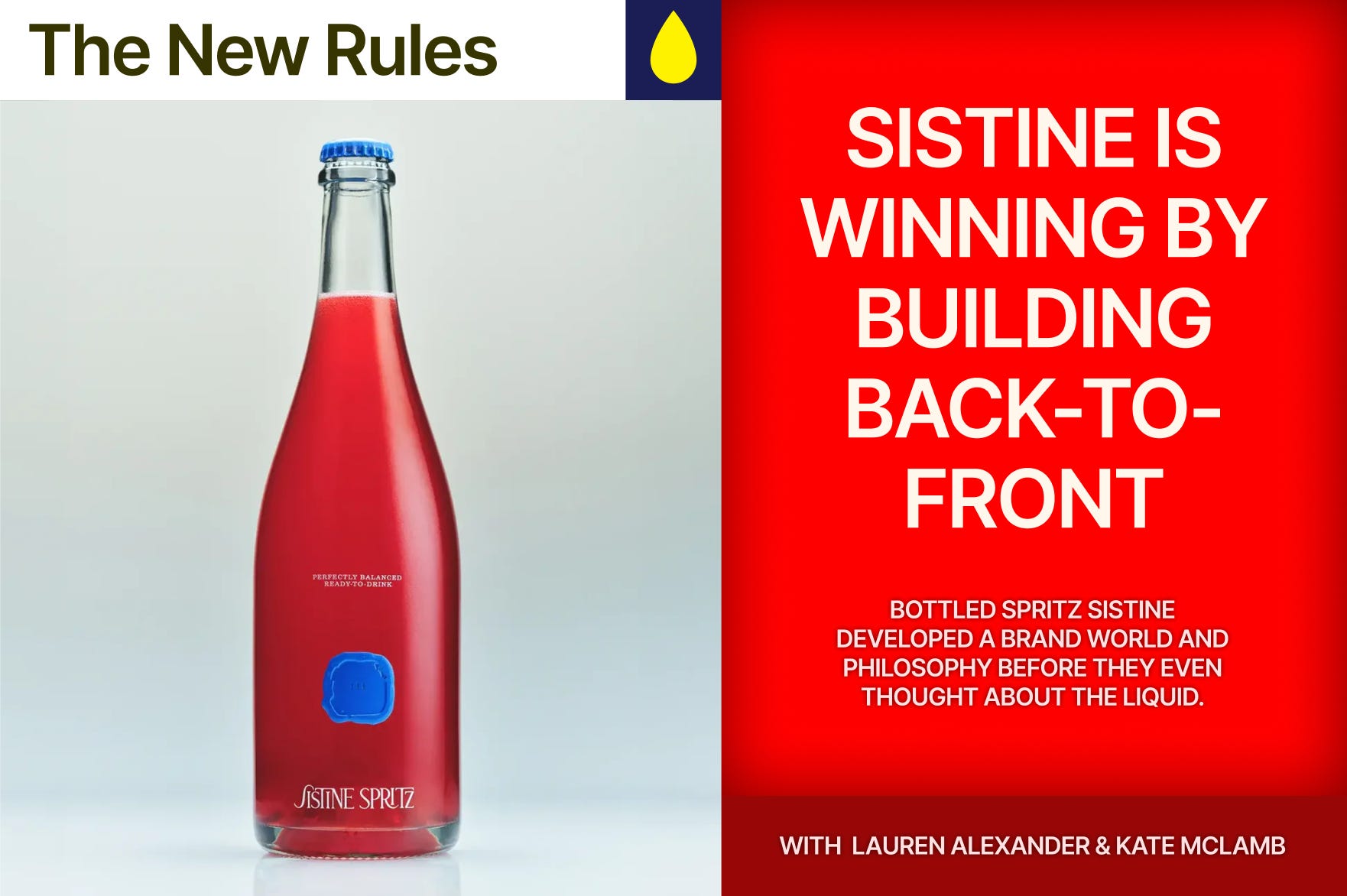
Most founders in bev/alc start with a liquid, then a bottle, then a distribution plan. But Sistine is doing things differently.
Founders Lauren Alexander and Kate McLamb did not start with a recipe; they started with a mood board. Drawing from Lauren’s 20-year background in fashion, they’re building Sistine as a lifestyle ecosystem that prioritizes curation and intuition over traditional corporate scaling.

The result is a brand that feels less like a grocery store staple and more like decor.
The branding-before-liquid strategy
Sistine started with the brand. They spent months with Black Ink Project – a branding agency in London – before a single drop was formulated.
As Lauren says: “We did branding and story before we ever had a drink, before we had formulated, before we knew what color it would be, anything”.
This wasn’t just about nice packaging. It was about defining the “World of Sistine,” a space that encompasses Spotify playlists, dinner parties, and a specific cultural milieu.
By the time they approached formulators, the visual and emotional parameters were so clear that the liquid had to rise to the challenge of the brand. Even the specific pink-orange hue was decided only after they saw a mockup that reflected that color.
Hosting as the core product
If you look at Sistine’s social presence, you’ll see as much hosting as you see liquid. Lauren jokes that they could have launched the brand and never had a beverage because they do so much entertaining.

The dinner party is not just marketing; it’s the brand’s origins. Lauren previously ran “Wine Society” in LA, curating natural wine dinners that evolved from educational sessions into wild, high-energy parties. That experience taught them how to build a world where people actually want to belong, using music and curation to set a mood that feels refined but never alienating.
The “anti-RTD” positioning
Sistine occupies an elevated “Third Space” between categories. While technically a pre-prepared cocktail, it intentionally avoids the “Ready to Drink” aisle. By using an organic Chardonnay base and natural botanicals, Sistine has earned spots on elite wine lists, a rare achievement for bottled cocktails.
The bottle: Aspirational in aesthetic while remaining accessible.
The can: Served with a “sidecar” of ice to create a modern, elevated ritual.
The placement: Positioned alongside pet-nats and natural wines, not sugary malt beverages.
The retail advantage: from outlier to pioneer
While restaurants offer credibility, the premium retail environment is the brand’s natural home. This is where the “anti-RTD” stance moves from a defensive position to an offensive market-share grab.
1. Overcoming the gatekeeper
In restaurants, Sistine can face a “purist” barrier from sommeliers trained in single-varietal terroir. In retail, that gatekeeper is replaced by a “curator” or shop owner looking for high-quality, hybrid products that solve a consumer need for premium convenience.
2. Visual discovery and context
Retail provides visual real estate that a wine list cannot.
The “adjacent” strategy: By sitting next to natural wines and premium aperitifs, Sistine uses retail “neighborhoods” to signal its quality without saying a word.
The hosting occasion: A shopper buying a chilled Gamay for a dinner party is more likely to grab a 4-pack of Sistine than they are to order a canned drink at a white-tablecloth dinner.
3. The education mandate
As a “category of one,” Sistine must bridge an education gap for both the trade and the consumer.
Sistine leads the conversation in defining this new category (part wine, part botanical cocktail).
Retail displays allow Sistine to teach the “sidecar” ritual, proving that the liquid deserves the same reverence as a hand-shaken drink.
In restaurants, Sistine is an outlier. In retail, Sistine is a pioneer.
Mastering the neighborhood
To protect the brand’s status, Lauren and Kate have resisted the urge to be everywhere at once.
Instead of a national “spray and pray” launch, they are mastering Los Angeles neighborhood by neighborhood. This hyper-local focus allows them to remain hands-on, often performing the tastings themselves at independent retailers.
“Until you can prove that you can take over and curate I think in a smaller section it’s hard to scale”.
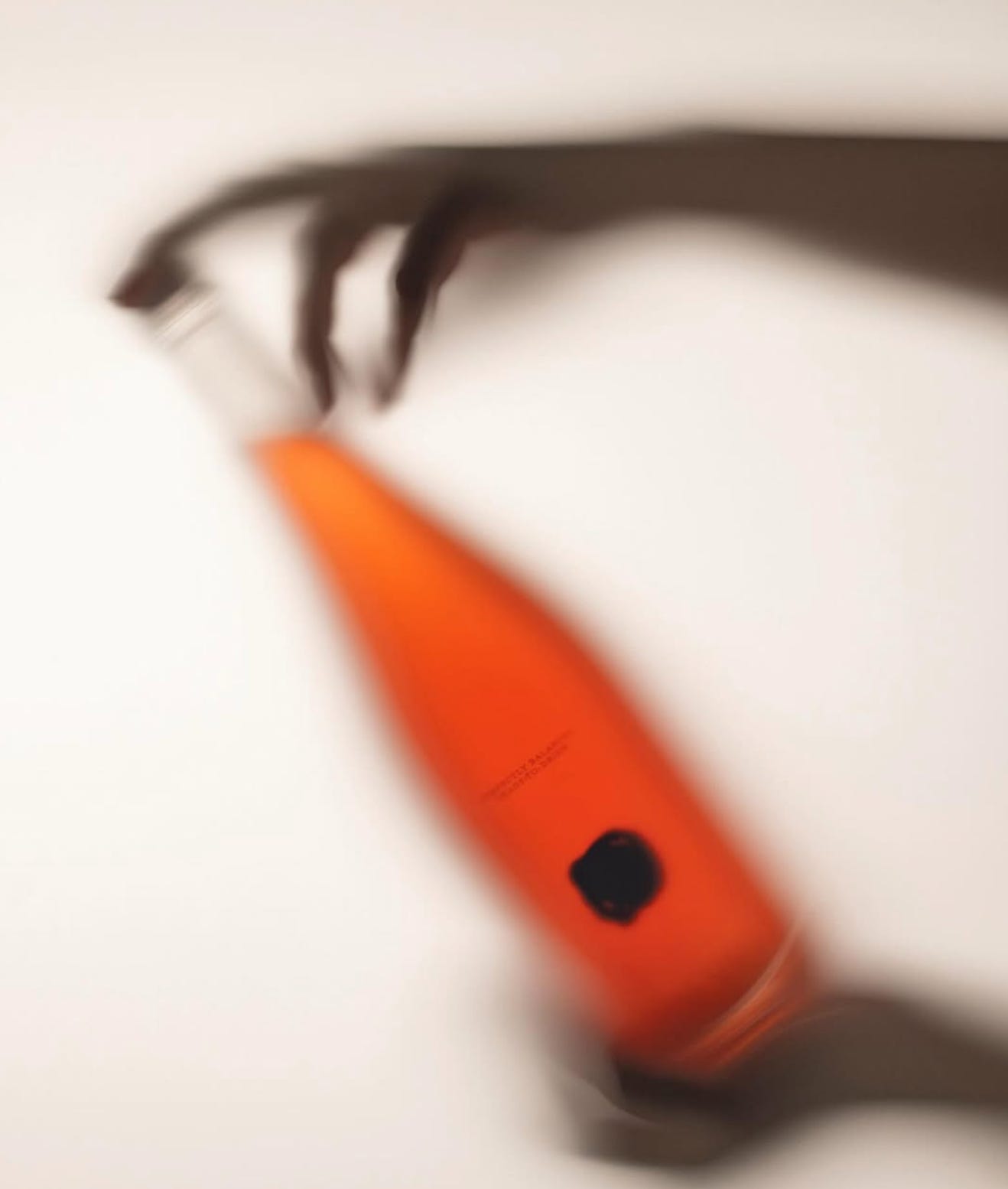
Lauren notes that people are often shocked to see the founders personally conducting the tastings at bottle shops. But for them, it’s a return to basics that provides direct feedback from buyers and creates genuine velocity through real human connection.
Operating on intuition
Perhaps the most radical “new rule” Sistine follows is its reliance on intuition and timing. From launching the website on 8/8 to consulting with an astrologer on business transits, the founders lean into their instincts as a strategic advantage.
“We are very woo woo,” Lauren said with full confidence.
Hell yes.
Go Sistine.
Lean into what it is that guides you.
There are no steadfasts in this industry, or this life. Let’s all drop the pretense that there are.
THE NEW RULE
Sistine reminds us that taste, both in liquid and in culture, cannot be fully automated - and that intuition is still the most fundamental thing we can all tap into. Don’t ever ignore it.
The New Rules is a labor of love by nihilo.agency
Need design support for your brand? Reach out! hi@nihilo.agency
And support our work by:
- Subscribing
- Sharing
- Inviting us to speak at your conference or event on branding/bev/alc
Cheers.