


Something is happening. I know something’s happening, because I went to my corner shop (in London) a few weeks back and spotted Suntory’s -196 shochu, vodka and soda RTD on the shelves, right next to BuzzBallz and cans of Heineken and Red Stripe.
It’s the first time I’ve seen it there, but it makes total sense because Suntory is actively expanding in Europe and the USA. It also makes sense because it’s a sign of changing tastes and interests.
We’ve all read about the influence of Korean and Chinese and Japanese culture, and we’ve all seen the growing enthusiasm for flavors from East Asia. You can see some of that in The New Rules coverage from the last 6 months – including soju cocktail brand Wild Mannered, and enzymatic cordial JIN JIN.
So when I spotted that British retail institution Marks and Spencer was stocking its first ever sake, I had to chat with the founder of the chosen brand: Dreamsake’s Matt Brunault.
The quick story of Dreamsake
Matt fell in love with sake in New York (he says the US is actually much farther ahead, in terms of beverage, btw. It got to kombucha, craft beer and natural wine first, and is also on its way to fully embracing makgeolli).
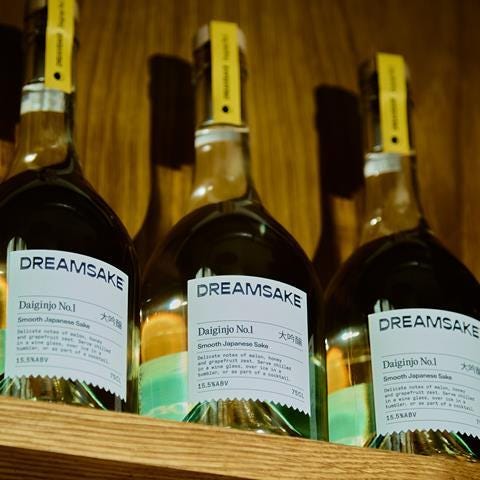
Seeing that sake was a hugely underappreciated spirit in the UK, and the west more broadly, he knew there was a space to do something. Matt found brewery partners in Japan, worked with them to develop a liquid that was “approachable” for a western audience, and identified a price point that would grab new sake drinkers who don’t want to commit too much to their first experience.
Education, pricing, flavor… sake is a balancing act
People might think of sake as a spirit, but it’s drunk more like a wine. And then to confuse things further, it’s at an interesting midpoint of strength. It’s not a beer-level ABV, nor is it spirit- or wine. It’s at the difficult middle.
As Matt says: “It throws you a bit, which is quite interesting.”
For the most part, people also don’t know how sake is made. “What’s challenging, especially for a brand like ours, is that there’s a huge amount of education,” says Matt.
Here’s a quick rundown of the making process, from him:
“You take rice and polish it. The more you polish it, the more you polish away the protein and the higher the ratio of starch to protein. Then you steam the rice and use koji – the same mold used in miso and soy sauce – which turns starch into sugar, and then yeast turns sugar into alcohol.”
The process yields different grades of sake depending on how much the rice is polished. Lots of polishing creates fruity, elegant flavors, less polishing produces more savory, rough, umami flavors – which, says Matt, people in the west aren’t so used to.
These rougher flavors are a lot of people’s first experience of sake, when they order the cheapest option on the menu at their local Japanese restaurant. That can throw them off and make life difficult for a sake brand that wants them to keep buying and trying. It means building in this space is a balancing act, first and foremost.
Dreamsake has to find the sweet spot in so many ways: the right price to convince people to try it; the right brand without playing on visual tropes; the right flavor to keep people drinking it; and the right level of explanation and education.
Japan needs those sake exports
It was a surprise, to me at least, to hear that in Japan, sake is actually in decline.
“It’s seen almost like an old man’s drink,” says Matt. “It’s a national heritage point, like pubs in the UK, but you read in Japan how many sake breweries are closing because the demand isn’t there. It’s really sad because there are all these historical and cultural points, but in Japan everyone’s drinking whiskey and beer and wine. For them, export is now really important.”
The good news is that just this year, The Drinks Business reported that sake exports from Japan are up (the second highest level on record), they’ve doubled since 2020, and the Japanese government has set a very ambitious target for the future.
In this environment, ripe with possibility, Matt hopes a brand like Dreamsake is a “stepping stone”. He admits that the category, in Europe at least, is tiny at the moment – and that’s difficult. However it’s also extremely promising, because there’s so much room for it to grow, and for other new sake brands in the west to uplift one another.
What is it about sake?
I think there’s a few reasons sake is really primed to explode.
1)We’re in the magpie era of consumer behaviour.
There are so many drinks brands on offer. People are extremely ready to be seduced by a cool new soda, or a beer brand with a great label, or a spirit they’ve never heard of.
Keeping them loyal is another story, but persuading them to try something new has maybe never been easier. Novelty is an enormous selling point. On top of that, people in the west have had years of gin, whiskey and wine being drummed into them via huge marketing budgets. But sake? Not so much. It’s new, and that’s very alluring.
2)Our cultural influences are evolving rapidly
Japan and Korea have gained huge cultural currency in recent years. Korean and Japanese beauty brands in particular have carved out a path, and I think smart bev/alc brands can follow that trail, and tap into a lot of pre-existing positive sentiment.
3)There’s something a bit deeper about all of this
I think the growing interest in sake and other East Asian flavors also speaks to changes in how people feel. Whether they’re aware of it or not, consumers are thinking more about ingredients and craft and time. They want less additives, and they want something that feels rooted in a deeper story. Not only is sake preservative and sulfite-free, but it’s born from a long, rich tradition.
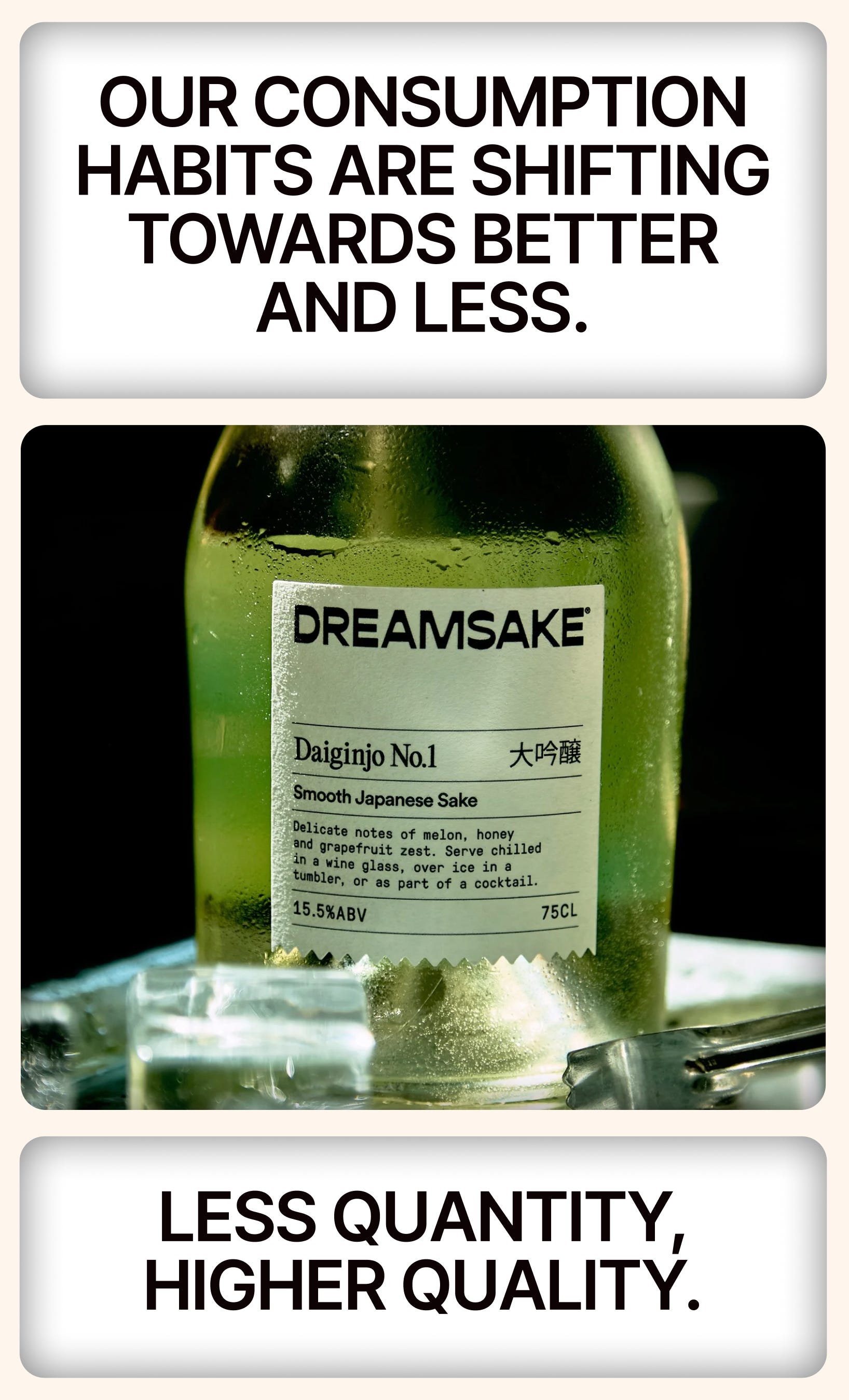
“What we really recognize, as a culture, is good craft,” says Matt. “When we look to Japan or Korea or China you see things that are well-crafted. There’s a real obsession with craft … I think our consumption habits are shifting towards better and less. Less quantity, higher quality. And I think in an ever-disconnected digital world, it gives our lives more meaning. Interacting with an Asian product just feels more expansive.”
It’s something that JIN JIN founder Sohn Supradya Aursudkij also told us:
“From soju to kombucha to regional drinks and ferments, they all have deep histories and beautiful craftsmanship behind them and people appreciate that now more than ever. There used to be outdated perceptions about Asian products not meeting certain standards, but that couldn’t be further from the truth. There are so many premium, carefully made foods and drinks coming from Asia. People today care about authenticity and story, and Asian flavors offer both.”
There’s a major opportunity here. If someone discovers and loves sake, that’s the first step of discovering more sake, and then more expensive sake. The potential is vast. And I think we’re on the verge of seeing a lot more sake brands – and drinks brands rooted in East Asia – come to the market. The challenge, as ever, is how they use branding, comms, and storytelling to find their place and then sell that to drinkers.
The New Rules is a labor of love by nihilo.agency
Need design support for your brand? Reach out! hi@nihilo.agency
And support our work by:
- Subscribing
- Sharing
- Inviting us to speak at your conference or event on branding/bev/alc
Cheers.