


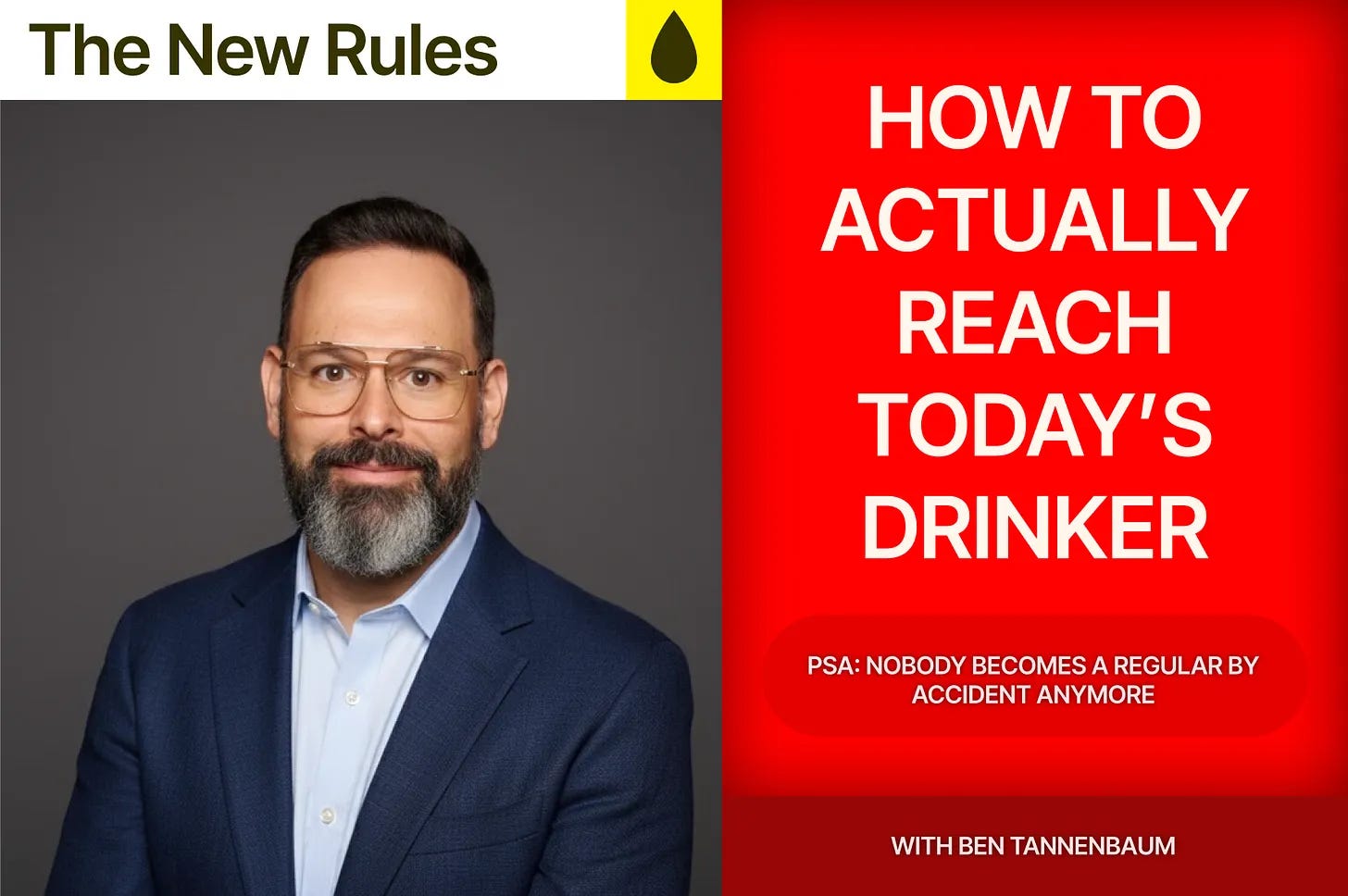
A conversation with Ben Tannenbaum of LineLeap on why the old playbook for reaching consumers doesn’t work anymore.
I sat down with Ben Tannenbaum, who runs alcohol strategy at LineLeap (the nightlife platform that lets people skip the line at bars and clubs, currently live in 800 venues across 125 markets, with about two million users, 98% of them under 30). Before that, he ran the alcohol vertical at Fetch Rewards for eight years, and before that he was in innovation roles at NBC Universal and Mastercard, watching how platforms and infrastructure change human behavior long before he ever touched alcohol.
That background is why this conversation didn’t stay on Gen Z drinking less. It went somewhere more useful: why the entire social structure that used to make drinking happen without anyone planning it is quietly disappearing, and what that means for how long a brand should even try to plan for.
The Shrinking Half-Life of a Drinking Occasion
Tannenbaum thinks about alcohol’s role in socializing as a series of eras, each shorter than the last. The tavern held that role for something like 250 years, doubling as the voting hall, the hiring hall, the place news actually traveled. Post-war happy hour culture, the version where you just showed up because that’s what people did after work, held it for about fifty. The craft and identity era, where what you drank signaled who you were, lasted maybe thirteen. The current wellness moment might get ten, if that.
“It used to be that you would have this 10-year planning horizon for what is my brand identity. I don’t think that makes sense anymore.”
He’s not arguing brand equity is worthless. He’s arguing that a brand rigid enough to ignore what’s happening over the next 36 months, in the name of protecting a 10-year plan, is taking on a different kind of risk now.
Why the Conditions Stopped Lining Up
Ambient drinking, the unplanned, casual kind, the run-in at the bar rather than the scheduled happy hour, only happens when five conditions line up at once. Here’s Ben Tannenbaum’s version of them:
Temporal synchronization: people are free at the same time.
Spatial concentration: people are physically near each other and near venues.
Low planning cost: you just go, someone’s already there.
Social permission: drinking is expected or has a legible role.
Repetition: the occasion recurs often enough to become habit.
When even one or two of those conditions erode, ambient drinking doesn’t happen. It’s not that people stopped wanting to drink together. It’s that fewer of the conditions line up anymore.
For Gen Z, several of these were never fully in place. More than 40% haven’t reached legal drinking age yet. A large share had their college years, exactly when temporal synchronization and spatial concentration used to happen automatically, interrupted by COVID. And a record number of 25 to 34 year olds are still living at home, which structurally suppresses the whole category of occasions this used to run on. This isn’t a generation that decided to drink less. It’s a generation for whom the ambient infrastructure never fully rebuilt itself.
The Causal Chain
Most alcohol marketing still treats occasions as things you sponsor after they already exist: the tailgate, the music festival, the happy hour that would have happened without you. That’s the bottom of the causal chain. You get impressions and an association, but the moment doesn’t need you.
Tannenbaum’s actual advice is to move to the top of that chain instead, to be the reason the occasion exists at all. He gave the example of a bar in Madison, Wisconsin running weekly Love Island watch parties, pulling numbers close to a Friday on a random weeknight. Nobody’s coming out to drink first and watching the show second. They’re coming for the event, and the drinking happens because they’re already there.
A few ways that shows up in practice:
Backing a trivia night that’s actually building repetition and proximity, not just buying a logo placement on something that already had an audience
Treating a venue’s recurring watch party or theme night as infrastructure worth investing in, not a one-off activation
Showing up as the invisible hand behind an occasion rather than the visible sponsor of one
The Occasions Nobody Has Claimed
Tannenbaum also pointed out how much brands default to the same four planning windows (holidays, summer, the Super Bowl) instead of the smaller, weirder occasions that are specific to someone’s actual life. Tequila shows up constantly around Cinco de Mayo, rarely around Mexican Independence Day or Dia de los Muertos, the occasions a Mexican or Mexican American audience would probably rather be spoken to on. The territory isn’t niche. It’s just unclaimed.
Regularmaxxing is a thing.
“Regular” used to be something that happened to you, a byproduct of a work schedule and a neighborhood bar that existed whether you showed up or not. Now it takes actual effort to become one, which is exactly why Gen Z had to invent a term for it (”regularmaxxing”) instead of just doing it the way everyone before them did without thinking twice.
That effort is the opening. The brands that win the next decade won’t be the ones showing up at the party. They’ll be the ones the party wouldn’t exist without.
The New Rules is a labor of love by nihilo.agency
Need design support for your brand? Reach out! hi@nihilo.agency
And support our work by:
Subscribing
Sharing
Inviting us to speak at your conference or event on branding/bev/alc/fun
Cheers.
In the bz-thought provoking! Respectfully reposting