


If your beer, soda or RTD doesn’t have electrolytes, protein, adaptogens, mushroom powder, colostrum or any other hypey ingredient in it, are you really even alive?
We’ve said it time and again at The New Rules, but it’s truly the era of drinks but ✨extra✨. And things are, arguably, being taken too far. We’ve put so much protein in stuff that there is, reportedly, a global whey protein shortage. We’ve raved so much about matcha that the Tokyo Metropolitan Government is paying tea growers to transition to matcha production.
Why can’t things just be simple? Why are so many brands being built around a hype cycle?

The innovation hook
To understand why the bev sector is so enchanted with trends, we spoke with Leah Keggi: a brand strategist and marketer with a good decade of bev industry experience. She started out in craft beer at a business that was later acquired by a major brewery, weathered the mania of the 2010s, and then moved over to work in wine and spirits. And along the way she became very familiar with how the drinks industry ties itself in knots over ‘innovation’.
She told us: If it feels like there’s more hypey ingredient focus than ever before that’s because the barrier to entry is lower, the trend cycle is faster, and news spreads more quickly. On top of that, new brands lacking loyalty often feel they need the ‘edge’ of being a bit weird to get attention.
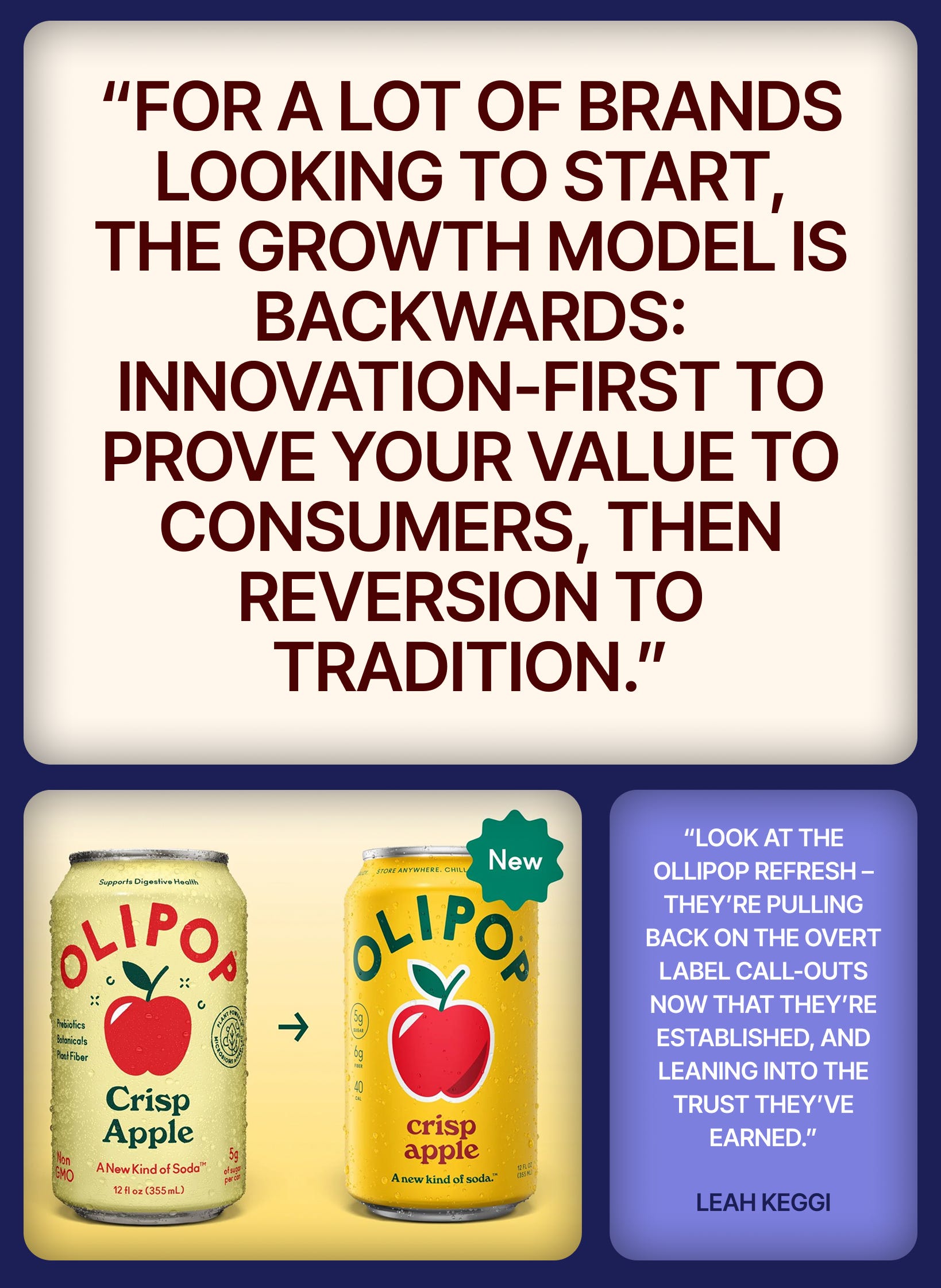
“For a lot of brands looking to start,” she explains, “the growth model is backwards: innovation-first to prove your value to consumers, then reversion to tradition. Look at the Ollipop refresh – they’re pulling back on the overt label call-outs now that they’re established, and leaning into the trust they’ve earned.”
Innovation ≠ acquisition
The problem is that add-ons can feel like a shortcut to success. They might feel like you’re tapping into a movement – and for a period, you are. But things change fast. And in reality, says Leah, chasing those often-fleeting moments can stop a brand from leaning into an audience and providing value. The trend feels like a solution, but it’s really a distraction. And while lots of young brands think the focus on innovation will pin down an acquisition, we’ve got news.
“People think they’re going to have a Poppi story,” says Leah. “I’ve seen this a lot in whiskey, because people think they’ll just bottle it. And actually, you have to do so much work to be attractive. People want to get acquired, so they give it a two-year run and they stop. That’s not enough time.”
The ‘what’s new’ trap
The trap, according to her, is asking: what’s new? The second trap is assuming that what’s new is what’s going to sell. People hope that innovation is going to help them leapfrog across categories or into consumers’ hearts, and while newness can be appealing, it’s much harder to be new.
“When the shelves were all one brand, you could slot in a new item and it was interesting, so people chose it,” Leah told us. “Now the shelves are packed. But people keep asking ‘what’s new?’ instead of ‘how are we talking about this?’ We’re chasing trends, and we’re asking questions that aren’t what the consumer is looking for.”
It’s understandable. The lure of the trend is powerful. It sings its siren call and brands follow. This is particularly risky for younger companies, says Leah, because often they’ve barely started bedding in with consumers, and then they start following weirdness.
Star Wars is cowboys in space
So how to do it? How do bev brands stay relevant without falling victim to a trend that eventually falters?
Leah says the trick is to take the familiar, and twist it ever so. Star Wars is cowboys in space. Absolut’s tabasco vodka is vodka, but spicy. There’s a hint of novelty; a touch of the unexpected but within a framework that’s still familiar. And it helps to pick things that have a reasonable lifespan.
Stores of the Wild West are classics for a reason. Spicy flavors have been loved forever, for a reason. They might feel fairly novel to the beverage category, and they might be in a moment of interest, but they’ve also got roots and they’ve got legs. And, importantly, it’s a good taste experience, wrapped in exceptional branding.
Take smaller steps
Brands need to think about innovation, yes, but they need to consider what form that comes in. Rather than launching a new addition that no-one wants, work on your brand.
“You can innovate your packaging, you can innovate to a new audience with the same products through marketing. Innovate your brand message or what your brands stands for. You don’t have to innovate product to sell more product. Tide isn’t making hand soap, they’re just making new types of detergent.”
And, perhaps, brands need to take smaller jumps. If you’re an alcohol-free beer and you release a limited edition nectarine version for the summer, that makes sense. The novelty could bring in some new interest, which could bring in new fans of your core brand. BUT, if you hear that everyone at Expo West is talking about tallow, and you’re now wondering how you can release a buzzy beef tallow beer, really ask yourself: why?
Ingredients aren’t competitive
Finally – and we cant emphasize this enough - you cannot compete on ingredients. Unless you’ve sourced something so rare and unusual that only you know where it grows or lives, it’s a dead-end.
”You need to build everything around the ingredients,” says Leah. “If everyone is using mushroom powders, what makes you special? You need to compete on your brand and your messaging to stick around for the long haul, because anyone can access ingredients – unless you’re like David, and you buy up the supplier.”
I think the beer sector is a perfect example of this. In essence, every major beer brand uses the same ingredient list. None of them are telling consumers, ‘wow, we’re made with hops’. Instead, they compete on brand. And beer brands are some of the most tribal and successful examples of branding you can think of.
So put down the beef tallow. Forget about protein, or adaptogens, or mushroom powders in such minuscule amounts that they make no difference anyway. None of that is marketing strategy. Don’t chase the ingredients or the trends, chase the people instead.
As Leah says: “CPG needs to stop trying to be the best in the room with other CPG brands. Start thinking about how you’re the best thing for the community or the room you want to be in. There is a lot of untapped potential in a lot of places.”
The New Rules is a labor of love by nihilo.agency
Need support for your brand? We do:
- Design
- Content creation
- Interviews
- Advisory
Reach out! hi@nihilo.agency
And support our work by:
- Subscribing
- Sharing
- Inviting us to speak at your conference or event on branding/bev/alc.
Cheers.
For the love of god don’t release a tallow beer 🤣🤣 Thanks for the opportunity to chat all things brand building innovation!